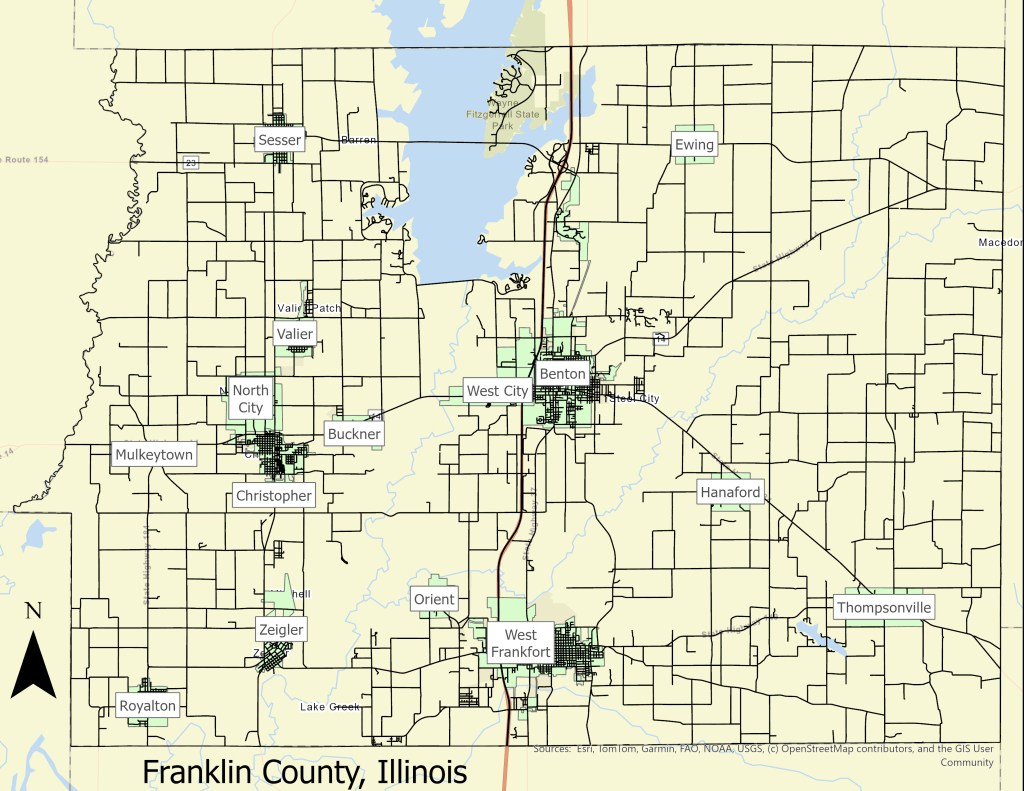
Franklin County, Illinois, Amateur Radio operators working with the Franklin County Office of Emergency Management & Communications, to provide assistance and to the public in time of an emergency.,
I. Introduction
A. The Amateur Radio operators of Franklin County is composed of FCC-licensed amateur radio operators who have voluntarily registered their capabilities and equipment for public service communications duty.
B. Under federal regulations, amateur radio public service communication is furnished without compensation of any kind.
C. The Amateur Radio operators Franklin County functions under this plan under the direction of the Franklin County Emergency Coordinator (EC).
II. Purpose
A. The purpose of this plan is to provide a written guide containing the minimum information that would be needed in an emergency; each emergency being different and flexibility to provide an adequate response to each is a necessity.
B. The primary responsibility of the to furnish communication in the event of a communication emergency when regular communications fail or are inadequate.
1. Any assignment as needed by the served Agency that INCLUDES communications.
C. All drills, training and instruction shall be carried out to insure readiness to respond quickly in providing effective amateur emergency communications whenever an occasion may arise.
D. The following agencies could be served during a communication emergency:
1. The American Red Cross
2. The Emergency Management Agency (EMA)
3. The Salvation Army
4. Hospitals
5. Police Departments
6. Fire Departments
7. Ambulance Services
8. National Weather Service
9. Any other agency requesting assistance from ARES
III. ACTIVATION
- In an emergency in which amateur operators may be alerted by any official from a served agency who notifies the Emergency Coordinator or one of the Amateur Radio operators
- Any Amateur Radio operators who for any reason suspects a communication emergency exists should monitor the assigned net frequency for activity.
- Should telephone communications be impossible follow the guidance listed in the mobilization plan.
- IN ALL CASES AMATEUR RADIO OPERATORS SHOULD NOT SELF DEPLOY; ONLY WHEN REQUESTED BY PROPER AUTHORITY.
IV. MOBILIZATION
A. When a communication emergency exists, alert messages shall be transmitted on 146.805 +.6 MHZ w/88.5 CTCSS. This is the local LEARS repeater, that is mounted on a WISPER Communications Tower East of Benton, IL.
B. Should the primary frequency be unavailable, members should use 146.440 simplex for information and instructions
Other frequencies that can be utilized in Franklin county are;
Shelter net 146.4250 simplex
Evacuation net 146.475 simplex
Hospital net 146.500 sim-plex
In case of multi-county emergency communications. Use:
146.5800 inter-county simplex
147.4200 Dist. 11 TACT
Digital Modes
2-meter State WINLINK frequency 145.610
2-meter District P2P WINLINK Frequency 145.160
HF WINLINK ARDOP/VARA 3.591/3.593 dial to station NC9IL
Statewide HF voice
3.905 LSB is primary frequency, 7.230 LSB is available also
C. The following should be considered as assignments for liaison station.
1. The American Red Cross
2. The Emergency Management Agency
3. The National Weather Service
4. National Traffic System
5. Amateurs in nearby counties
6. Commercial broadcast radio and TV station
7. Local Police departments
8. Local Fire departments
9. Local Hospital
10. The Salvation Army
11. Local Ambulance Service
- Backup and/or relief stations should be organized to replace stations who are already in service. (Share the load it makes the task easier).

